Codex
Reads intent, researches evidence and prepares options.
Live · release v245 Built for the OpenAI WebMCP Challenge Open source · MIT on GitHub
 inite
inite
Live product
Finite / public build record
The engineering behind Finite: an agent can propose a different plan, but it cannot approve its own changes. Here is how that boundary works, with the source and tests to inspect.
Back to the productEngineering / Codex for judgment, code for control
Codex handles language and research. Finite's code handles arithmetic, constraints, persistence and approval.
Reads intent, researches evidence and prepares options.
Checks constraints, binds revisions and rejects stale or unapproved writes.
Commits the plan head, revision, receipt, events and evidence in one transaction.
The current plan is an immutable revision with a replayable history.
Conservation rules, locks and relationships run in code.
Prices, availability and other observations are stored with provenance and treated as untrusted.
WebMCP cannot create authority. Every accepted mutation consumes one exact server challenge bound to its target, content and revision.
A failed write restores state and idempotency so the same operation can be retried.
Each operation records input, result and plan-context hashes.
Current scopeFinite can model, compare and revise a plan. It does not yet change bookings, make purchases, pay suppliers or report that another system acted.
Build log / recorded milestones
The latest recorded milestones, followed by the earlier build history. Test totals belong to their dated release, not every subsequent change.
 View full size ↗
One concrete change
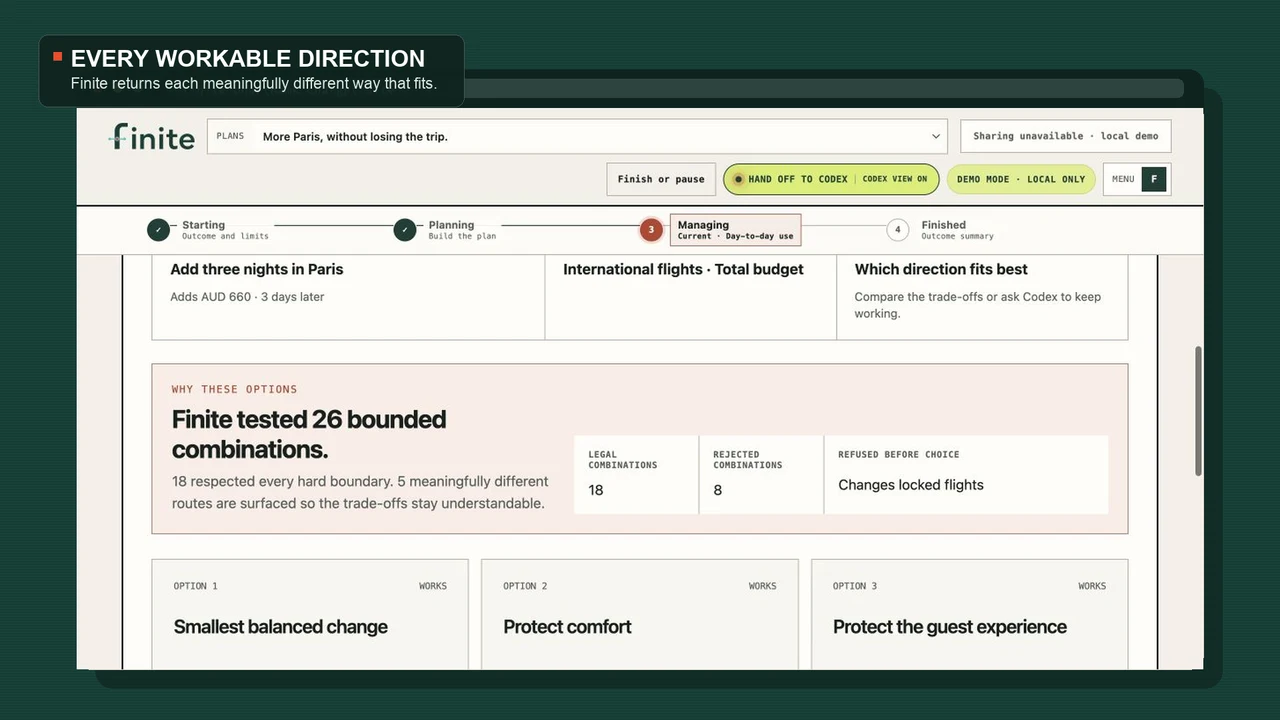
Eighteen passing combinations would be a lot to compare. The Paris example groups them into five distinct directions, so the person can choose what to protect. The search is bounded by the model's permitted changes, not every possible real-world solution.
Read the search tests ↗ · Inspect the full example and its limits
Finite returns every meaningfully different workable direction it finds instead of forcing every plan into three choices. The public Spotlight example checks 26 combinations, accepts 18, rejects eight and returns five distinct directions; another plan can honestly return one.
The full repository, acceptance records and reproducible release instructions are published with continuous verification. The public tree independently passes 373 of 373 tests, type checks, production builds and the submission gate.
A remembered demo must not override a deliberate fresh start or collaboration link. Release v242 corrected those entry paths alongside invalid money and date handling. Dialogs also retain failed edits and restore keyboard focus, so an error does not make the person start again.
A browser-local walkthrough resumes across reload, the Site-selected entry is canonical, pre-connection status is truthful and a replayed apply changes nothing. Console, 1280 px and 390 px overflow checks are clean on production.
Sixteen sequential real-interface journeys were run against the candidate, the defects they exposed were repaired and the full regression gate passed before release.
Starting a new plan consumes an independently stored human-action challenge, the visible move into Managing stays under half a second, and a renovation plan activates with its own cross-family semantics.
Arrival, planning, managing, completion and sharing run as one continuous interface. Three real Chrome stress scenarios passed and temporary test state was reversed.
Browser state is tenant-scoped, new accounts begin empty and D1 stores the complete hash-validated compiler definition needed to reconstruct a custom adaptive surface on another device.
Options, corrections, preferences, lifecycle, group decisions, external-action truth and plan activation all require an exact server challenge. Arrival closure also proves the current durable plan head.
Travel, renovation and event completed ordinary changes, late shocks, bounded recovery and honest conclusions. Seven permanent browser tools now open only the bounded semantic manifest needed for the current route.
The entry packet checks arrival work against accepted-plan work and returns up to three routes grounded in current state. Suggestions, research, validated options and human decisions are stored as different states.
The handoff points a fresh task to finite_enter_kitchen. Finite returns the current arrival, accepted plan, authority state and next route. Plan contents stay in the product.
Human input is append-only. Checkpoints, version checks and staged clarification prevent an older session from overwriting later plan state.
Travel uses a calendar, renovation uses a phase lane and event uses a run of show. Each surface has its own measures, language, entities and actions. State and approval rules remain shared.
D1 commits the plan head, revision, receipt, domain event and evidence in one transaction. ChatGPT identity derives the tenant. Finite does not store the credential.
Codex can orient, research, compare and stage. Approval creators sit outside WebMCP. Every consequential command binds to one candidate and revision.
Reproduce the recorded release ↗ · Inspect repository verification ↗
Roadmap / what needs to work next
Make starting and returning dependable, then make Finite easier to run independently. Booking and payment integrations come later: approving a plan must never imply permission to spend.
Finite / product
Return to the product page to see the same planning engine adapt across travel, renovation, events and your own outcome, or open the live product and run the walkthrough yourself.